Get your own free Blogoversary button!

Gypsy's Travels


Showing posts with label Italy. Show all posts

Tuesday, July 22, 2014

The National Museum - Written July 2013

Breakfast as usual, coffee / hot chocolate and pastry at the "Bar." The man behind the counter seems to be a little friendlier each day. David and I sit outside today and enjoy the coolness of a shaded table by the sidewalk. As we leave, we are focused on our planned visit to the National Museum. I vaguely register a disturbance from the area we left, so I quicken my pace hoping to avoid any trouble. Every day on our way here, we pass what we think is an embassy. We don't know which one and don't recognize the flag but there are always one or two armed military and a military vehicle stationed in front .
The shouting gets louder and David turns to see what is happening. Rushing along behind us is our "friend from behind the counter of the coffee shop." He is breathless, clearly annoyed, and shouting at us in Italian. We notice the man is waving David's camera in the air and clearly berating us. We don't understand any of his words, so David calmly retrieves his camera, we smile and say 'thank you'. Later, I theorize the man was concerned that we were very vulnerable to the thieves and  pickpockets that prompt all the warning signs. We'll see how he responds to us at breakfast tomorrow.

We tried to see the Capitolini Museum yesterday, but arrived too close to closing time. There was a huge crowd of people gathered in the Piazza so we waaited to see what was happening. After a long while, we asked around and discovered the Mayor of Rome was scheduled to speak to the assembled group. David took this photo:

Mayor of Rome, Italy
The National Museum is filled with statuary and artifacts dating from before Christ. It still amazes me that everything can be so old and well preserved. David states later that "everyone in Rome must have run around naked" because all the statues are naked or barely clothed. He is getting quite an education! We saw duplicate statues of a hermaphrodite in two different museums. She is lying on her side, only partially exposed. The difference is in presentation. One museum puts the art form in a central position where it can easily be seen from all sides. The other museum places the form at an angle near the wall that requires some serious neck-craning to get a full view. I wonder why.

Not being an artist, I find it difficult to maintain an interest in marble, carved heads. Then I notice a focus on hair styles, which are apparently useful in dating and identifying statues. Some of the men sport women's styles, especially the male sports figures.
Feminine style on male athlete


Style favored by matrons


Wednesday, July 10, 2013

The Roman Forum

The Forum is an area of serious ruins. Over the centuries it has been pillaged and vandalized, yet it retains its air of aristocracy. Lone pillars mark the spots where proud buildings once towered. It was originally a marketplace but it grew into "the most celebrated meeting place in the whole world, and in all history." The Forum was a place where the people of Rome could gather for commercial. political, judicial, and religious pursuits. I was struck by the ostentatious life styles some of these people must have led and their sophistication.


A tradition of speaking to the public from the rostra was established early (prior to 361 BC). About 44 BC, Marc Antony delivered his famous funeral oration for Caesar from the New Rostra, and 2 years later displayed the severed head and right hand of Cicero, his mortal enemy.


Although Julius Caesar was cremated after his death and his ashes scattered, this grave site behind a low wall at the Forum is still honored by the populace.

Tuesday, July 9, 2013

Palatine Hill

I believe we were dealing with temperatures in Rome similar to the ones we left in Texas. The only difference was Roman temps were in Celsius compared to our Fahrenheit, which made the Celsius seem cooler. So, 32*C does not sound too hot before it is converted.  As a rule of thumb, David tells me, 28* C is about 82* F. We were not really thinking about temperature conversion and heat index, we were just plain hot and walking under a bright, bright sun. Nevertheless, we were drinking in every possible moment along with plenty of water.

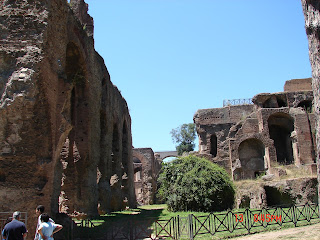
Following the crowds from the Colosseum, we wandered across the street to Palatine Hill. This was a less crowded area with some shady spots along the way. This place, according to Roman mythology,  was where a she-wolf found Romulus and Remus and kept them alive. Palatine Hill stands at the center of the "seven hills of Rome" and is thought to have been inhabited as early as 10th century BC. There is archaeological evidence of a Bronze Age settlement. Palatine Hill became a fashionable place to live and, at one time, was covered with imperial palaces.


On Palatine Hill, amid the sheltering trees and centuries -old ruins, we had a lunch scavenged from our backpacks - cherries and bananas bought at a street market near the hotel and a packs of crackers/ snacks left from the airplane.

Somehow, Palatine Hill is impressive. Maybe it  has something to do with the view or the lack of crowds, but it holds its head high and says"accept me for what I am, and was."


We were met at the top of a lengthy set of stairs by a man offering bottles of water - 2 bottles for 1 Euro.

 We had depleted our water supply and were miserably thirsty, but I had not seen water that cheap anywhere else in Rome. Red Flags went off in my head - too cheap means trouble so, as thirsty as we were, I declined his offer. He had met us just before we hit the top step so he must have been a pro, knowing how thirsty the tourists would be. We had not gone 100 steps further when we discovered a water source in a nearby grotto. People were happily drinking and filling their bottles, so we joined them. The water was good and quite cold. We drank our fill and refilled our water bottles. I can only imagine that the man offering to sell us water had refilled some empty bottles of unknown and questionable source.
We continued traversing the extensive grounds, trying to visualize the life of affluent occupants from ages past. The "Hippodrome" was once a garden area with columns, statues, landscaping, and fountains. Currently, several displays of various art forms give a modern touch to the ancient ruins.


????


Continuing on the upper level of the Hill, we discover remnants of "palaces" built by the affluent citizens of Rome. Here the air was cleaner, they could dodge the diseases of the common people, and they had beautiful views of the countryside.


The area consists mostly of ruins and excavated parts of buildings from which archaeologists continue to piece together the history surrounding the people of the area.

The Palatine Museum houses artifacts, excavated from the area,  dating as far back as the Middle Paleolithic Period, and works of art.
A fresco


There is much of interest here and it deserves more time, but the brain can only absorb so much at one time and the body can only endure so much heat. We reluctantly leave to find our way to the Roman Forum.

Thursday, July 4, 2013

An afternoon Expedition to Santa Maria degli Angeli e dei Martiri

 We continued on our afternoon excursion, passing up a piazza crowded with canopied tables filled with wares for the busy Italian shoppers, and headed toward our destination, Piazza della Republica Roma. We were seeking the Basilica Santa Maria degli Angeli e dei Martiri (Basillica of St. Mary of the Angels and the Martyrs) .
The photo appears calm and quiet but there are usually hordes of vehicles bearing down on you as you attempt to cross.  We learned to always use the crosswalks. Pedestrians do have the right of way in the crosswalks but you should not rely on vehicles to stop. Once you make the move to cross, keep moving - the vehicles do plan to miss you! Since we were still intimidated, we learned to watch the locals and walk with them!


 Santa Maria degli Angeli e dei Martiri


 This building was originally part of the massive (some 130,000 square meters) remains of the Baths of Diocletian  until 1541 when a Sicilian priest had a vision of angels in the ruins. The Pope viewed the vision as a message from God and ordered a church built on the site and dedicated to the Virgin Mary, the angels, and the Christian slaves who had died building the original baths. Guess that covered everyone.


Door of Basilica Santa Maria degli Angeli e dei Martiri -
The Risen Christ


In 1563 Michelangelo, commissioned to design the church, began his work but he died the next year. His design was completed by Jacopo Lo Duca and the church was given to the Carthusian monks, who built a monastery next to it.


In 2006, two bronze doors, by sculptor Igor Mitora replaced the old wooden ones


Basilica Santa Maria degli Angeli e dei Martiri door handle -
the Virgin Mary


 "Light and Time"
Stained glass by Narcissus Quagliata 1999


The dome of the Basilica is the result of many changes over the years. Originally a circular opening in the rotunda of the Baths to allow rain to fall into the water below, it has evolved to the present stained glass masterpiece. "The glass cupola is not attached to the ancient roof fabric, but rests on three gilded steel spheres and thus leaves a narrow gap all round for ventilation."


Main altar
It seems every church in Italy has, at least, a small claim to fame - a relic, a masterpiece, an attributed miracle, etc. This church has a Meridian Line commissioned in the 8th century by Pope Clement XI. It was completed in 1703 and provided the standard for local Roman time until 1846.

The sun enters through this prism "eye"
Sun shines along this Meridian Line


We did not get to see the sun mark its path this time, but it will be on my list for next time.


Apparently, the church has special exhibits that travel through. We found this one: Isochronism in the Oscillation of the Pendulum.
 "Here in the exact words of Galilei: 'The other truly marvellous thing is that the same pendulum oscillates with the same frequency, or just slightly, almost indistinguishably, different.' Galileo Golilei, Opere IV, 475-476" "The regularity of pendular movements opened new horizons on something in which Golilei firmly believed, namely the universality of all movements, whether they be rectilinear, circular, or parabola.
This was no mean feat. Since the dawn of civilization rotating movements had been considered to belong to the heavenly spheres. The consequence of the discovery that all movements are manifestations of the same entity, that of motion, was that stones had the same status as stars."

We gave the pendulum a little swing


Off to one side, there is an unassuming little room with a history and drawn plans of the Baths of Diocletian.  That room opens on to a small enclosure which, I believe, must have been one of the small gardens allocated to the monks just outside their cells. The Carthusian monks took a vow of silence but were allowed some conversation / quiet interaction every Thursday. The area has a few remnants of architectural interest strewn about.


Part of the monks' cells?


"This statue is a gift from China to
the State Basilica of Saint Mary of the Angels and Martyrs."


 "This bronze statue of Galileo Galilei Divine Man was designed by Professor Tsung Dao Lee, winner of the 1957 Nobel Prize in Physics, Director of CCAST (China Center of Advanced Science and Technology) and WFS (China) President.


Finally, the floor of the church was amazing! I wonder if I could make a quilt with this pattern......